mercredi 27 mars 2019

CRelated Auto Repair articles-11

Misc. Articles

Auto Repair
Résultat de recherche d'images pour "‫محلات تصليح السيارات‬‎"
Auto Repair is something no motorist can avoid, unless you are trading cars every couple of years for brand new ones. Even then, you might get a lemon. The more you drive your car and the more miles you put on your engine, brakes, transmission and other systems, the more likely your vehicle is to need auto repair at some point. The question is when? This article on What Goes Wrong with Cars and When can give you some insight into what type of auto repairs may be looming in your future.
Auto Repair Topics
If your car or truck is having a problem and you need auto repair advice such as how to diagnose your car problem or even how to fix it yourself, see the articles in this list of COMMON CAR PROBLEMS (by symptom).
For a more complete listing of car repair topics on the AA1Car.com website, see our Alphabetical Index of Car Repair Articles
If you are searching for a local auto repair shop or other repair facility, see: Car Repair Shops
Another auto repair issue is that of avoiding Auto Repair Fraud & Ripoffs. Nobody wants to be overcharged or sold parts or services they don't really need by an unscrupulous mechanic. So take a look at this article on Auto Repair Guidelines.
Reducing the need for auto repair requires regular Car Maintenance such as oil changes, filter changes, checking vital fluid levels and making sure your vehicle is in good operating condition and is safe to drive. If your Check Engine Light is on, your vehicle has an emissions problem. Diagnosis with a scan tool will be required to determine why the light is on and what fault codes are present.
Auto repairs can be expensive. If you need some insights into what it might cost to fix your car, see this article on Auto Repair Costs.
If you want to fix your car yourself, here are some tips on which Auto Parts are replaced most often, and also where to buy Auto Parts.


If you are the do-it-yourself type and are not afraid to attempt some of your own car repair work, be warned that many car repair jobs today require special tools and know-how, things like an up-to-date scan tool that can access and read diagnostic trouble codes, sensor information and other operating data. In addition, you may need additional diagnostic information such as test specifications, wiring diagrams, parts locations and replacement procedures to fix your car. Auto Repair Manuals are available from various sources, and factory service information can be purchased online directly from the car makers. You can also get the same factory service information from automotive aftermarket suppliers such as AlldataDIY.com.


If You Need Factory Service & Repair Information for Your Car or Truck, Click this Banner:

ALLDATAdiy - Diagnose, Repair, Research 

A subscription to AllData gives you access to all of the factory service information for your year, make and model
of vehicle for a full year. You can add other vehicles you own too.
This includes access to all of the same information new cars dealers have including diagnostic charts,
repair procedures, service specifications, maintenance recommendations, parts locations, part numbers,
wiring diagrams, labor times, technical service bulletins and recalls.


 Related Auto Repair articles:

Car Repair Advice: How Much Should It Cost To Get Your Car Fixed?

Car Repair Advice: How To Avoid Auto Repair Fraud Scams & Rip-Offs

Car Repair Advice: What Goes Wrong With Cars (and When)

Car Repair Advice: Most Often Replaced Car Parts

5 Car Noises You Should Not Ignore

5 Warning Lights You Should Never Ignore!

5 Ways To Save Money on Auto Repairs

5 Things Your Car May Need Now!

Look up Technical Service Bulletins & Recalls for Your Vehicle 

OEM Automotive Service Information Websites & Access Fees

Trouble Code Help

Lubrication & Maintenance articles 10

Lubrication & Maintenance articles


What Every Motorist Should Know About Motor Oil

 Motor oil does more than just lubricate an engine. It also forms a film on bearing surfaces that lifts and separates moving parts so they don't touch to reduce friction and wear. The oil film also acts like a shock absorber to cushion reciprocating and rotating parts. Oil also serves as a coolant for critical engine parts such as the crankshaft bearings and valve-train. Oil also helps prevent rust and corrosion inside the engine, and helps keep surfaces clean by dissolving and carrying away dirt and varnish deposits.


UNDERSTANDING OIL VISCOSITY

"Viscosity" refers to how easily oil pours at a specified temperature. Thinner oils have a water-like consistency and pour more easily at low temperatures than heavier, thicker oils that have a more honey-like consistency. Thin is good for easier cold weather starting and reducing friction, while thick is better for maintaining film strength and oil pressure at high temperatures and loads.


The viscosity rating of a motor oil is determined in a laboratory by a Society of Automotive Engineers (SAE) test procedure. The viscosity of the oil is measured and given a number, which some people also refer to as the "weight" (thickness) of the oil. The lower the viscosity rating or weight, the thinner the oil. The higher the viscosity rating, the thicker the oil.
Viscosity ratings for commonly used motor oils typically range from 0 up to 50. A "W" after the number stands for "Winter" grade oil, and represents the oil's viscosity at zero degrees F.
Low viscosity motor oils that pour easily at low temperatures typically have a "5W" or "10W" rating. There are also 15W and 20W grade motor oils.
Higher viscosity motor oils that are thicker and better suited for high temperature operation typically have an SAE 30, 40 or even 50 grade rating.
These numbers, by the way, are for "single" or "straight" weight oils. Such oils are no longer used in late model automotive engines but may be required for use in some vintage and antique engines. Straight SAE 30 oil is often specified for small air-cooled engines in lawnmowers, garden tractors, portable generators and gas-powered chain saws.
Engine Lubrication System
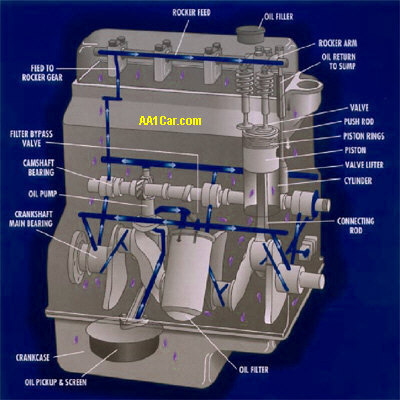
Engine oil system 

MULTI-VISCOSITY OILS

Most modern motor oils are formulated from various grades of oil including base stocks refined from crude oil and recycled re-refined oil. The base stock determines the lubrication characteristics of the oil. Multi-viscosity oils contain polymer "viscosity index improvers" that alter the way the oil flows at both high and low temperatures. Multi-viscosity oils flow well at low temperature for easier starting yet retain enough thickness and film strength at high temperature to provide adequate film strength and lubrication.
A thin oil such as a straight 10W or even a 20W oil designed for cold weather use would probably not provide adequate lubrication for hot weather, high speed driving. Likewise, a thicker high temperature oil such as SAE 30 or 40 would probably become so stiff at sub-zero temperatures the engine might not crank fast enough to start.
Multi-viscosity grade oils have a wide viscosity range which is indicated by a two-number rating. Popular multi-viscosity grades today include 5W-20, 5W-30, 10W-30, 10W-40 and 20W-50. The first number with the "W" refers to the oil's cold temperature viscosity, while the second number refers to its high temperature viscosity.

Motor oil viscosity recommendations chart

WHICH OIL VISCOSITY TO USE?

Most vehicle manufacturers today specify 5W-20 or 5W-30 motor oil for year-round driving. Some also specify 10W-30 or 0W-20. Always refer to the vehicle owners manual for specific oil viscosity recommendations, or markings on the oil filler cap or dipstick.
As a rule, overhead cam (OHC) engines typically require thinner oils such as 5W-30 or 5W-20 to speed lubrication of the overhead cam(s) and valve-train when the engine is first started. Pushrod engines, by comparison, can use either 5W-30, 10W-30 or 10W-40.
As mileage adds up and internal engine wear increases bearing clearances, it may be wise to switch to a slightly higher viscosity rating to prolong engine life, reduce noise and oil consumption. For example, if an engine originally factory-filled with 5W-30 now has 100,000 miles on it, switching to a 10W-30 oil may provide better lubrication and protection.
For sustained high temperature, high load operation, an even heavier oil may be used in some situations. Some racing engines use 20W-50, but this would only be recommended for an engine with increased bearing clearances. Increasing the viscosity of the oil also increases drag and friction, which can sap horsepower from the crankshaft. That's why 20W-50 racing oil would not be the best choice for everyday driving or cold weather operation for most vehicles.
The latest trend in racing is to run tighter bearing clearances and use thinner oils such as 5W-20 or even 0W-20 to reduce friction and drag.

ADDITIVES MAKE THE OIL

Up to 25% of the liquid in a typical quart of oil is additive. Additives are what really make the oil and determine its performance properties. Additives extend the viscosity range of the oil, allow it to withstand high pressures and loads, handle contaminants in the crankcase, and reduce friction for improved fuel economy.
One of the most important additives is "Viscosity Index (VI) Improvers". These help the oil maintain a consistent viscosity as temperature and load change. "Pour point depressants" are also used to prevent the oil from thickening at low temperature for easier starting.
Modern motor oils also contain detergents and dispersants to reduce varnish and sludge formation to keep the engine clean. There are also "anti-oxidants" to minimize oil burning when the oil gets hot. This also helps reduce the formation of varnish and carbon deposits inside the engine.
Rust and corrosion inhibitors are added to counteract the harmful effects of water, unburned fuel and exhaust gases that blow past the rings and enter the crankcase. This prevents the formation of acids that can pit bearing surfaces. "Foam inhibitors" are used to minimize the formation of air bubbles as the oil is churned by moving parts. "Wetting agents" help the oil stick to hot surfaces so it doesn't run off and leave the metal unlubricated and unprotected.
Finally, there are "anti-wear" and "extreme-pressure" additives. These include zinc and phosphorus (ZDDP) that provide wear protection when metal touches metal. A small amoun tof molybdenum may also be used as an anti-wear additive. Racing oils typically have a higher dose of ZDDP to provide extra protection in high revving, high load applications. Older pushrod engines with flat tappet camshafts also requires higher levels of ZDDP in the oil. For more on this subject, see ZDDP - What is it and Why do you need it?.


API MOTOR OIL SERVICE CLASSIFICATIONS

The "service rating" of motor oils is classified by the American Petroleum Institute (API). The program certifies that an oil meets certain OEM quality and performance standards. The service rating is shown in the API "Service Symbol Donut" on the product label. There may also be an "API Certified for Gasoline Engines" seal on the label.

API Motor oil service rating donuts

The latest service category rating for gasoline engines is SN for 2011 and newer model year vehicles. This replaces the previous SM rating that was introduced in November 2004 for 2005 and newer engines. SN-rated oils along with the previous SM, SL and SJ ratings, are all backwards compatible and can be safely used in older engines. But the opposite is not true. Older obsolete service classifications (SH, SG, SF, etc.) may not meet OEM lubrication requirements for newer engines. Likewise, API SL oils should not be used in 2005 and later vehicles, and SJ oils should not be used in 2001 and newer vehicles.

For diesel engines, API has a separate rating system. The current category is CJ-4 for 2007 and newer diesels. CI-4 was introduced in 2002 for diesels that have exhaust gas recirculation) and can be used in 2002 to 2006 diesel engines. The previous CH-4 (introduced in 1998) can be used in 2002 and older diesels. Previous API classifications CG-4 (1995) and CF-4 (1990) are now considered obsolete. CF-2 (1994) is the API classification for two-stroke diesels.
API also gives oils an "Energy Conserving" rating if the oil meets certain criteria for reducing friction and oil consumption, and improving fuel economy. Most 5W-20 and 5_30 oils meet this classification.
Motor oils that meet the API SN rating are equivalent to oils that meet the International Lubricant Standardization and Approval Committee (ILSAC) GF-5 specifications, which some European and Asian auto makers require. SN rated motor oils typically meet the previous GF-4 standards.
In October 2010, the ILSAC introduced a new "GF-5" motor-oil standard that provides better oil life, fewer deposits, less sludge and improved protection for turbochargers and the catalytic converter.
For 2011, General Motors announced a new oil requirement called "dexos." GM says their new oil performance specification is better than the new GF-5 specification, which also went into effect in 2011. GM says dexos is required in all 2011 and newer GM engines, and is backwards compatible with older engines that use SM oils.
There are two versions of dexos: dexos1 for gasoline engines and dexos2 for diesel engines. The specification calls for a high quality synthetic base stock with additives that provide high temperature, high sheer characteristics to reduce friction for better fuel economy, to reduce piston ring deposits and sludge, and to extend oil life (necessary for use with GM's Oil Life Reminder System).
Because it uses high quality synthetic base stocks, dexos and other brands of oil that meet GM's dexos specification are more expensive than conventional motor oils. GM is licensing oil brands that meet their specifications. Pennzoil Platinum and Quaker State Ultimate Durability both claim to meet the new dexos spec in their SAE 5W-30 viscosity grade motor oils.
Click here for information about the latest New Motor Oil Specifications 2014.

WHY MOTOR OIL NEEDS TO BE CHANGED

Regardless of an oil's API service rating or additive package, all motor oils eventually wear out and have to be changed (actually, it's the additives that wear out more so than the oil). As the miles add up, motor oil loses viscosity and gets dirty. The oil no longer has the same viscosity range it had when it was new, and it contains a lot of gunk (moisture and acids from combustion blowby, soot, dirt and particles of metal from normal wear). You can't really tell much about the condition of the oil by its appearance alone because most oil turns dark brown or black after a few hundred miles of use.
The oil filter will trap most of the solid contaminants, and the Positive Crankcase Ventilation (PCV) system will siphon off most of the moisture and blowby vapors -- if the engine gets hot enough and runs long enough to boil the contaminants out of the oil. Even so, after several thousand miles of driving many of the essential additives in the oil that control viscosity, oxidation, wear and corrosion are badly depleted. At this point, the oil begins to break down and provides much less lubrication and protection than when it was new. If the oil is not changed, the oil may start to gel or form engine-damaging varnish and sludge deposits -- and eventually cause the engine to fail!

When oil isn't changed often enough, it turns to sludge

Oil life depends on many factors including driving conditions (speed, load, idle time, etc.), environmental factors (temperature, humidity, airborne dirt), and engine wear. As a general rule, most experts still recommend changing the oil and filter every 3,000 miles or six months, which ever comes first. Why? Because this provides the best all-round protection for the average driver.

EXTENDED OIL CHANGE INTERVALS

In recent years, many vehicle manufacturers have extended their recommended oil change intervals to reduce maintenance costs for the vehicle owner -- and have run into trouble. The Center for Auto Safety (www.autosafety.org) has logged over a thousand complaints about oil sludging problems from motorists who thought they were following the service intervals recommended in their owners manuals but ended up with a crankcase full of sludge.
Extended oil change intervals of 7,500 or 10,000 miles or more are based on ideal operating conditions, not the type of short trip, stop and go driving that is typical for many motorists. Consequently, most drivers should follow a "severe" service maintenance schedule rather than a "normal" service schedule to protect their engines.
Severe service includes:
* Most trips are less than 4 miles.
* Most trips are less than 10 miles when outside temperatures remain below freezing.
* Prolonged high speed driving during hot weather.
* Idling for extended periods and continued low speed operation (as when driving in stop-and-go traffic).
* Towing a trailer.
* Driving in dusty or heavily polluted areas.
Some engines, such as diesels, suffer more blowby than others and typically require more frequent oil and filter changes. For most passenger car and light truck diesels, the oil should be changed every 3,000 miles without exception -- especially in turbo diesels.
Turbocharged gasoline engines also require more frequent oil changes because of the high temperatures inside the turbo that can oxidize oil. A 3,000 mile oil change interval is also recommended for all turbocharged gasoline engines.

OIL REMINDER LIGHTS

General Motors, BMW and some of the other luxury brands have done away with recommended oil change intervals altogether and now use an "oil reminder" light to signal the driver when an oil change is needed. Some technicians now refer to this as the "Replace Engine Soon" light because of the sludging problems that have resulted from extending oil change intervals too far. The oil reminder systems estimate oil life based on engine running time, miles driven, ambient temperature, coolant temperature and other operating conditions. On some of these vehicles, the light may not come on until 10,000 miles or higher! But keep in mind that most of these engines are factory-filled with higher quality "synthetic" oil, so be sure to replace same with same when you change oil on these engines.

OIL ANALYSIS

One of the arguments against changing oil at specific mileage or time intervals is that the oil may still be good. As long as the additive levels in the oil are adequate and the oil is not oxidizing, breaking down or contaminated with fuel or coolant, there's no need to change it. Oil reminder lights are better than mileage/time intervals in this respect, but the light is still a guesstimate that may or may not be accurate. The only way to know for sure when the oil really needs to be changed is to test it. A sample of oil can be sent to a lab for analysis, and the report can be used to establish a change interval that reduces unnecessary maintenance. Many fleets use oil analysis to determine oil change intervals, but for the average motorist, oil analysis is probably too expensive and inconvenient. The cost of the oil analysis is almost as much or more than an oil change.


SYNTHETIC MOTOR OILS

Synthetic oils are oils that are refined to a much higher degree than ordinary oils. Synthetic oils are premium oils that generally have greater viscosity stability, lower pour points and can withstand higher operating temperatures. Synthetic oils improve cold starting, reduce friction, reduce oil consumption and improve fuel economy and performance -- but they typically cost about three times as much as regular motor oil.
Some suppliers of synthetic motor oils say the higher cost of their premium quality synthetic oil can be offset by extending oil change intervals. But this would depend on the operating conditions, age and condition of the engine.
Synthetic oils are a good upgrade for most engines, but are not recommended for breaking-in newly rebuilt engines.
UPDATE Oct 30, 2007: A new green synthetic motor oil made from beef tallow (animal fat) is now available as an alternative to petroleum-based oils. The new oil is 100% biodegradeable, non-toxic, and safe (you can even drink it!). Performance is similar to other synthetic oils but it costs a little less. The product is called G-OIL.
For more information about synthetic oils, try these links:
AMSOIL Synthetic Oil

Castrol Synthetic Oil

G-OIL Green Motor Oil (biodegradeable synthetic oil from beef tallow)

Mobil1 Synthetic Oil

Pennzoil Synthetic Oil

Quaker State Synthetic Oil

Redline Synthetic Oil

Royal Purple Synthetic Oil

Valvoline Synthetic Oil

SYNTHETIC BLENDS & SPECIALTY MOTOR OILS

For motorists who want the benefits of a synthetic oil in a less expensive product, there are "synthetic blends" that mix 20 to 25% synthetic oil with conventional oil. Blends cost about a dollar a quart more than ordinary oil, and provide many (but not all) of the benefits of a full synthetic.
There are also oils that have special additive packages for specific applications such as large, heavy Sport Utility Vehicles (SUVs), turbocharged engines (extra anti-oxidants) and high mileage engines (extra viscosity improvers and anti-wear additives).

Oil filler cap

OIL CHANGE TIPS

* Drain the oil while it is hot. Contaminants will be in suspension and drain more easily from the engine.
* Always replace the filter when changing the oil.
* Wipe some oil on the filter gasket so the seal won't stick or tear.
* Hand tighten the filter about 1/2 to 3/4 of a turn after the gasket makes contact. Over-tightening may damage the threads or gasket, and make the filter difficult to remove the next time the oil is changed. Under-tightening may allow the filter to work loose and leak.
* If the oil is badly contaminated or sludged, the crankcase should be cleaned and flushed before the engine is refilled with oil.
* Always check the oil level after refilling the crankcase. Start the engine, then shut it off and check the oil level after several minutes. It should be at the full mark on the dipstick. Most engine hold about four or five quarts of oil, plus half a pint to almost a quart for the filter (depending on the size of the filter). Overfilling can cause oil foaming and leaks. Under-filling may cause a loss of oil pressure and engine damage!
* Dispose of your old used oil properly. Save it in a container and take it to an auto parts store or other facility that recycles oil. Do NOT dump it on the ground, down a storm sewer or anyplace else where it would contaminate ground water.

More information about motor oil can be found at MotorOilMatters.org.

News Update: March 15, 2011

Valvoline Introduces NextGen Recycled Motor Oil

Valvoline NextGen motor oilThe Valvoline Oil Company is now selling a new motor oil called NextGen that contains 50 percent recycled motor oil. The product meets all current SAE and API motor oil performance requirements, and sells for the same retail price as Valvoline's conventional motor oils.
NextGen is packaged in green plastic bottles (which also contain a high percentage of recycled plastic) and is available in all common viscosity ratings (5W20, 5W30, 10W30 and 10W40) in both conventional and MaxLife blends.
Valvoline says Americans use about 800 million gallons of motor oil every year. If a high percentage of this could be changed over to recycled motor oil, it would greatly reduce our dependence on virgin motor oil from both domestic and foreign sources.
The re-refined base stock oil that makes up half of each quart of NextGen is made from recycled motor oil and other lubricants. The used oil is filtered to remove solid contaminants, distilled to remove chemical contaminants, and reconstituted by adding hydrogen under high temperature and pressure. The end result is a base stock recycled oil that is essentially the same as a high quality virgin base stock, says Valvoline. The company says they back their product with the same guarantee as their conventional and synthetic motor oils.
For more information about NextGen recycled motor oil, Click Here.

Update: November 2012

API Wants Quick Lube Shops to Certify Oil Quality

The American Petroleum Institute (API) has launched its licensing efforts for motor oil distributors and oil change locations as part of its expanded Motor Oil Matters (MOM) campaign. Created to bring together everyone involved in the sale of bulk motor oil to the public, including motor oil marketers, distributors and oil change locations, the MOM campaign is designed to ensure that consumers get the quality motor oil they are paying for.
Monitoring the quality of motor oils sold in bulk has been a challenge, says API. Others have reported instances of substandard quality oil that does not meet performance specifications finding its way into distribution channels and quick lube shops. Cheaper low quality oil increases profit margins for distributors and quick lube shops but it also increases the risk of costly engine damage or engine failure resulting from inadequate lubrication.
The MOM campaign complements API's current oil quality monitoring program and is designed to provide greater assurance that the industry markets, delivers and installs high-quality motor oils. This will be accomplished by maintaining a secure chain-of-custody for bulk motor oil from the marketer all the way to the vehicle.
Earlier this year, API published the industry's first standard for establishing motor oil chain of custody, outlining basic procedures to ensure that distributors are able to confidently identify the oil that they deliver to oil change locations, and that these locations in turn are able to identify the oil they pour into customers' vehicles. Every customer of a Motor Oil Matters licensed location will receive a written receipt with the brand name, viscosity and performance level of the oil installed in his or her car.
API will certify motor oil distributors and oil change locations, identifying them as businesses committed to delivering quality oils. These distributors and locations will be able to market and advertise themselves as trusted service providers.
For more information about the Motor Oil Matters program, visit MOM.


Update: October, 2013

New Oil Change Regulations Start January 1, 2014 in Many States

The U.S. Commerce Department's National Institute of Standards and Technology has recommended the adoption of new standards for Motor Oil information on service invoices. So the next time you get your oil changed at a quick lube facility, repair shop or new car dealership, your repair bill should list the brand, viscosity and API service rating of the oil that was put in your engine. Shops are also required to have labels on all containers, including bulk storage tanks, that display the same information. Shops must also retain a copy of the repair invoice for one year after the date of sale.
The reason why repair facilities are being asked to do all of this is to hold them accountable for the quality of oil they are installing in their customer's vehicles. In other words, this new law is to help assure consumers that they are getting what they pay for, not a lesser quality oil, the wrong viscosity oil (which can cause problems in some vehicles) or the wrong brand or service grade of oil.
The new requirements go into effect January 1, 2014 in 20 states, with more states being added after the regulations are reviewed. The states where the law is in effect include AK, AR, CT, IL, ME, MO, NH, NV, NC, OK, RI, SC, TN, TX, UT, VA, VT, WA, WV and WI.


Update: April 2014

Watch Out for Poor Quality Oil in Quick Lube Shops

The quality of oil being sold by quick lube shops has come into question in recent years. The American Petroleum Institute (API) did a nationwide survey in 2013 to check the quality of oil being sold by quick lube facilities. Oil samples were taken from bulk dispensers in quick lube shops and analyzed in a laboratory to see if they meet API quality standards, OEM performance requirements and SAE viscosity grades.
The survey found that 1 out of 5 samples FAILED one or more of these tests!
The survey found that a lot of quick lube shops are selling poor quality oil that does not meet minimum service specifications or is not the correct viscosity grade. Poor quality oil increases the risk of lubrication-related engine damage and failure. For more information on this issue, see Motor Oil Matters.


 More Motor Oil & Lubrication Articles:

New Motor Oil Specifications 2014

How Often Should You Change Your Oil?

How To Change Your Oil

Certified Master Technicians Speak Out On Oil Change Intervals

API Motor Oil Classifications

Motor Oil Additives

ZDDP - What is it & Why do you need it?

Motor Oil Viscosity

Re-Refined Motor Oil

Synthetic Motor Oil

Oil Filters

What To Do If Your Oil Pressure Warning Lamp Is On

Troubleshooting Low Oil Pressure

Oil Pump Diagnosis

ignition diagnosis Ignition & Spark Plugs Articles 9

ignition diagnosis Ignition & Spark Plugs Articles


spark plugs

Spark Plugs

Copyright AA1Car Adapted from an article written by Larry Carley for Underhood Service magazine
Spark plugs have been around almost as long as the internal combustion engine. In 1902, spark plugs were first used with a high voltage magneto to provide reliable ignition. For the next 70 years, spark plugs were a high maintenance item thanks to tetraethyl lead, which was used as an octane-boosting additive in gasoline. Unfortunately, lead tended to foul spark plugs after 12,000 to 15,000 miles of driving. Consequently, tune-ups and spark plug changes were an annual ritual for most motorists.


Then came the Clean Air Act of 1970, followed by new emissions regulations and the introduction of catalytic converters in 1975. Leaded gasoline was gradually phased out because of its damaging effects on converters as well as the environment. As a result, spark plug life more than doubled.


In the mid-1980s, spark plug manufacturers started making plugs with copper core center electrodes. Copper is an excellent conductor of heat and allows plugs to run hotter without causing preignition. This improves fouling resistance, ignition reliability and plug life. It also reduces the number of plugs needed to cover a range of engine applications because each plug has a broader "heat range."
The biggest improvement in spark plug technology, though, came in 1985 when the first generation "long life" plugs with platinum or gold-palladium electrodes hit the market. Up to this point, electrode wear usually dictated when a set of plugs had to be replaced. With standard nickel alloy electrodes, the spark gap between the center and ground electrodes grows about .0002" to .0006" for every 1,000 miles of driving. After 35,000 miles of driving, the gap can grow as much as 0.015" or more.
Every time a spark plug fires, the hot spark blasts a few molecules of metal off the electrodes. As the miles add up, the electrode gap widens and the center electrode becomes rounded and dull. This increases the firing voltage needed to jump the gap. Eventually the point is reached where the ignition system can't generate enough juice to jump the gap, causing the plug to misfire.
With platinum, gold-palladium and iridium (more on this in a minute), electrode wear is greatly reduced. Most platinum plugs can go up to 100,000 miles before they have to be replaced. The same is true for plugs that use iridium for their center electrode. Plugs with platinum or iridium on both electrodes ("double" platinum plugs or double iridium plugs) experience even less wear than plugs with only a single platinum or platinum-tipped electrode.
Long-life spark plugs drastically reduce the need for maintenance while helping the engine maintain like-new performance and emissions. Not having to change the plugs so often is a real savings for the vehicle owner, but it's no guarantee the plugs will go the distance.

Platinum & Iridium Spark Plugs

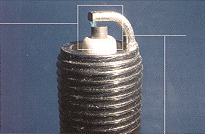
Long-life spark plugs by ACDelcoAutoliteBoschChampionDenso,NGK, and Split-Fire all have platinum or iridium electrodes. With a couple of exceptions, the platinum plugs use a conventional electrode configuration with a small platinum plug welded to the tip of one or both electrodes. ACDelco also offers a platinum version of its "Rapidfire" plug that features a fluted center electrode for improved ignition reliability. Likewise, Split-Fire offers a platinum version of its split electrode plugs for motorists who want extended life as well as reduced misfiring. By comparison, iridium plugs have a small wire center electrode.
bosch platinum spark plug 

Bosch, who introduced the first platinum plug back in 1985, offers several different electrode configurations in their product line. Their standard platinum plug has a thin pure platinum center electrode with a single yttrium-alloy end electrode. Their Platinum+2 and Platinum+4 plugs, on the other hand, have a unique "surface gap" side electrode design with two side electrodes on the Platinum+2 plug and four on the Platinum+4 - a sort of good, better, best approach to platinum plug technology. Increasing the number of side electrodes gives the spark more paths to ground and reduces the risk of misfire, while extending plug life by spreading wear over more electrode surfaces.
In the fall of 2006, Bosch introduced yet another long-life spark plug called Platinum IR Fusion. Similar in design to the Platinum+4 plug, this plug uses a center electrode made of a unique iridium/platinum alloy. The four side electrodes are a wear-resistant yttrium alloy. By combining platinum and iridium in the center electrode, Bosch says their Platinum IR fusion plug provides even longer service life (probably the longest of any spark plug that is currently available). Bosch also says their new Platinum IR Fusion plugs are an ideal replacement for any engine that comes originally equipped with either iridium spark plugs or platinum spark plugs.
One important point to keep in mind with respect to Bosch Platinum IR Fusion, Platinum+4 and Platinum+2 plugs is that these plugs are pre-gapped at the factory to a uniform 1.6 mm setting and should not be re-gapped to the specifications for a standard spark plug. It's very difficult to get even spacing with multiple electrodes so install them without changing the electrode gaps.
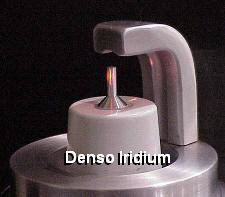
denso iridium spark plug

Although platinum spark plugs have many performance advantages over conventional spark plugs, iridium spark plugs offer even more advantages. The most important advantage is the longest service life of any spark plug (up to 4X longer than a standard spark plug, or 120,000 miles for many applications. Iridium last so long because the metal alloy is even more wear resistant than platinum. Iridium is usually alloyed with rhodium, creating a center electrode that is six times harder and eight times stronger than platinum. It is also one of the densest metals known.
Iridium has a melting point of 4370 degrees F (2410 degrees C), which is almost 1,200 degrees higher than platinum. It is a precious metal like platinum, which makes it expensive. But currently iridium sells for about half the cost of platinum ($540 ounce for iridium versus $1200 ounce for platinum November 2014).
NGK "Iridium IX" and Denso brand "Iridium Power" plugs ae used as original equipment in many Asian vehicles. On late-model Toyota and Lexus applications, the OEM-recommended replacement interval for Denso iridium plugs is 120,000 miles.
The iridium plugs have a very thin (0.4 mm to 0.7 mm depending on the plug) center electrode. On first generation Denso iridium plugs, the end electrode has a "U-Groove" that improves ignition reliability and wear resistance. Denso says their design reduces the required firing voltage up to 5,000 volts compared to a standard spark plug.
For performance applications, Denso has also developed Iridium Power plugs with a super narrow 0.4 mm center electrode. These plugs are engineered to improve ignition reliability under extreme driving conditions.
In 2014, Denso introduced their new Iridium TT spark plug with an iridium/rhodium alloy center electrode and platinum tipped ground electrode. The Iridium TT spark plug center electrode has a 0.4 mm needle tip, composed of a patented iridium/rhodium alloy that offers exceptional protection against corrosion and high-temperature oxidation. The ground electrode also has a 0.7 mm platinum button that is designed to resist oxidation and wear. These small electrode tips reduce the firing voltage needed to create a spark, which reduces misfires. They also create less interference for the ignition flame to expand and fully complete the combustion process, according to Denso. The twin tips extend plug life and help concentrate the spark for improved combustion efficiency and reduced misfires.


The use of iridium spark plugs as original equipment in late model vehicles has grown considerably in recent years due to its performance and cost advantages. Iridium plugs are often used in engines with Gasoline Direct Injection for improved ignition reliability. Iridium spark plugs have also become a good upgrade option for replacing standard spark plugs or platinum spark plugs in older engines, too.
Where does iridium come from? Much of it came from outer space according to Denso. Approximately 50 million years ago, a giant asteroid smashed into our planet near the Mexican town of Chicxulub in Yucatan. The impact created a firestorm and dust cloud that darkened the Earth for years, wiped out the dinosaurs and left us with a layer of iridium-rich deposits that is evenly spread across every continent (the "K/T boundary" layer). Iridium is often combined with platinum in mineral deposits, and is recovered as a byproduct of nickel mining.


Spark Plug Electrode Magic

Spark plug manufacturers tout the advantages of their unique electrode designs, but regardless of the design, the purpose is to make it as easy as possible for the plug to fire reliably. A spark jumps more easily from a sharp edge than a rounded blunt edge. So the more sharp edges it has to jump to, the better the odds of the plug firing under all types of driving conditions. The electrodes on some spark plugs are also designed to "unshroud" the spark so more of the spark will be exposed to the air/fuel mixture. This improves the propagation of the flame kernel once the fire is lit.
One thing to keep in mind with respect to performance claims is that no spark plug creates horsepower out of thin air. A special electrode configuration can reduce misfiring and the voltage needed to fire the plugs. But the spark only ignites what is already in the combustion chamber. If there are any power gains to be had, they will be the result of reduced misfires and nothing else.

Ruthenium Spark Plugs

The latest development in spark plug technology is Ruthenium Spark Plugs. Electrodes made of a special ruthenium alloy are said to last 2X longer than current iridium spark plugs, and 4X longer than standard nickel electrode spark plugs. The increased wear resistance of the electrodes means these plugs may truly become "lifetime" spark plugs that never need to be replaced. They are also said to offer better ignitability for improved performance, emissions, fuel economy and acceleeration.
NGK Ruthenium spark plugs NGK RUTHENIUM HX Spark Plugs

Spark Plugs Getting Smaller

Another trend in the ongoing evolution of spark plugs is that plugs are shrinking. The Ford Triton engines use long-reach 10 mm plugs from Autolite, which are 4 mm skinnier than the 14 mm plugs you're used to seeing in most late-model engines. The threads on these plugs are also 1-3/8" above the end of the plug, so heat has a long ways to travel before it can be dissipated through the threads into the cylinder head. This requires a couple of tricks to manage heat. One is an unusual "U" shaped end electrode that wraps all the way over the end of the plug. Connecting both ends of the electrode to the plug shell creates two paths for heat to flow away from the tip. The end electrode is made of a special high temperature Inconel alloy. In the center of the "U" is a small platinum pad to reduce electrode wear when the plug fires. The center electrode is also platinum tipped and has a copper core to help pull heat away from the tip.
Autolite is also marketing a "Titanium" spark plug. It's actually a standard spark plug with platinum tipped electrodes, but with a special titanium coating on the shell that resists seizing to reduce the risk of thread damage when changing plugs in aluminum cylinder heads.

Spark Plug Fouling Resistance


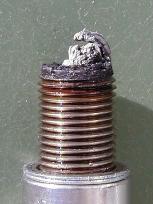
fouled spark plug

One thing all types of spark plugs must do is resist fouling. The trick here is to keep the electrodes hot enough to burn off fouling deposits but not so hot that they cause preignition. To burn off carbon deposits, the center electrode needs to reach about 700 degrees F quickly. But if it gets too hot (above -1,500 degrees F depending on the plug design), it may ignite the fuel before the spark occurs, causing preignition and detonation. For most plugs, the ideal operating temperature is around 1,200 degrees F.
The temperature of the electrodes is controlled by the length of the ceramic insulator that surrounds the center electrode and the design of the electrode itself. Ceramics do not conduct heat very well, so an insulator with a relatively long nose will conduct heat away from the electrode more slowly than one with a relatively short nose. The longer the path between the electrode and the surrounding plug shell, the slower the rate of cooling and the hotter the plug.
A spark plug's "heat range" (heat rating), depends on the length of the ceramic insulator and the design of the center electrode. The heat range must be carefully matched to the engine application otherwise the plugs may experience fouling problems at idle or run too hot under load causing preignition and detonation. Most plugs today have a relatively broad heat range thanks to the copper core center electrode described earlier. This allows the plugs to reach a self-cleaning temperature quickly and also prevents them from overheating.

Spark Plug Misfires

The voltage required to produce a spark can range from as little as 5,000 volts to as much as 30,000 volts or higher. The actual firing voltage will vary depending on operating conditions such as engine load, rpm, temperature, compression and the richness or leanness of the air/fuel mixture. The wider the electrode gap and the greater the load on the engine, the more voltage it takes to fire the spark plugs. Likewise, the higher the resistance in the spark plugs and plug wires, the higher the required firing voltage.
A cylinder may misfire if the spark never reaches the plug due to excessive resistance or breaks in the insulation in the plug wires, or a buildup of oxide, cracks or an excessively wide air gap inside a distributor cap. A weak coil or a faulty ignition module that doesn't give the coil enough time to fully charge between firings also can reduce the available firing voltage to the point where the spark may be too weak to jump the electrode gap. Of course, worn or dirty spark plugs also can make an engine hard to start, idle roughly, lack smoothness, waste fuel and pollute, too.
The most common cause of ignition misfire at the spark plug is fouling. A buildup of fuel and oil residue or other contaminants on or around the plug's electrodes can short out the spark before it reaches the gap. Contaminants also can form a barrier that blocks the gap or requires more voltage to punch through than the ignition system can deliver. The contaminants come from fuel additives as well as oil that gets past the rings and valve guide seals. A high-mileage engine with worn rings, cylinders and/or valve guides will often have a plug fouling problem.
On 1996 and newer vehicles with OBD II, ignition misfire will usually set a fault code and turn on the Check Engine light. Fuel that isn't burned causes a huge increase in hydrocarbon emissions and will usually cause a vehicle to fail an emissions test. Unburned fuel also can damage the catalytic converter by causing it to overheat. So if you find a cylinder-specific misfire code such as P0302 (indicating cylinder #2), check the spark plug, plug wire, coil (if it's a DIS or coil-on-plug system), fuel injector and compression to isolate the cause. On the other hand, if you find a random misfire code (P0300), the problem probably is not the ignition system. It's likely a lean fuel mixture caused by a vacuum leak or dirty injectors.

Reading Spark Plugs


spark plug diagnosis chart
 Click on image to view Spark Plug Diagnosis Chart.

Reading the condition of the old spark plugs can reveal a lot about other problems that may be going on inside the engine, things like lean fuel mixture, rich fuel mixture, oil burning, overheating, overadvanced ignition timing, detonation/preignition and more. Replacing the spark plugs will not solve any of these problems, and the new spark plugs will likely suffer the same kind of fouling, wear or damage unless the underlying problem is diagnosed and repaired.

Replacing Spark Plugs


As a rule, replacement spark plugs should have the same or better service interval as the original plugs. The brand does not matter, though many vehicle owners and technicians prefer to use the same brand of spark plug as the original when they replace plugs.
Long-life platinum and iridium spark plugs cost more than standard spark plugs but are an excellent upgrade for engines that were not originally equipped with these types of plugs. Most late model engines, however, come factory-equipped with long life platinum or iridium spark plugs.
If your engine has been fouling spark plugs, the plugs that you are using may be too cold for your kind of driving. Switching to a plug with a slightly hotter heat range may be necessary o solve a fouling problem. Fouling can occur if a vehicle is not driven very often or is not driven long enough or fast enough to keep the spark plugs clean.
For performance applications, switching to a slightly cooler spark plug can reduce the risk of pre-ignition and detonation at high rpm and loads.
When you change your spark plugs, wait until the engine has cooled. Trying to remove spark plugs from a hot aluminum cylinder head increases the risk of stripping the plug threads in the head. If a plug sticks or binds as you try to remove it, spray some WD-40 around the base of the plug, wait a few minutes, then turn the plug back in. Then slowly try to back it out again. Repeat as needed each time it binds until the plug eventually comes out. If you try to force it out, you will probably damage the threads in the head. Share 

Choosing Racing Spark Plugs

Selecting the proper spark plugs for a performance engine can mean the difference between front of the pack and not finishing the race. When using this guide, understand that race plugs are usually of a much colder heat range rating than standard automotive spark plugs. Colder spark plugs must be used in engines with increased cylinder pressures, higher temperatures and greater horsepower. Other factors such as fuel delivery (turbo, supercharged), fuel types and piston-to-head clearance will also affect proper plug selection.
Step 1: Shell Design - The first step in choosing the proper race spark plug is determining the plug type that your cylinder head/piston will accept. Thread diameter and pitch, thread length and shell seat, as well as hex size are all factors that will define what shell type works best for your engine.
Step 2: Electrode Design - The second decision is electrode design and configuration. Is it a fine wire center or standard electrode? Projected or non-projected? Full coverage 'J-Gap' or perhaps a cut-back or angled ground wire? A good rule of thumb is to attain as much projection into the cylinder as possible. But be aware of piston clearance that could prohibit projected spark plugs from being used.
Step 3: Heat Range - The third factor in choosing a race plug is heat range. Correct heat range is critical in maintaining peak performance throughout the duration of your race or event. Switching to a colder or hotter plug will not increase horsepower, but could affect engine performance. Choosing a plug that is too hot can result in preignition or detonation. A plug that is too cold could cause an engine to stumble, misfire or foul.
The main factors to consider in selecting the proper heat range are: type of race, methanol, specific output, nitro-meth, compression ratio, nitrous oxide, horsepower, super or turbo charging and racing fuel.
Courtesy: Champion Spark Plugs


Spark Plug Replacement Tips

  • Before you install any spark plug, compare the old and new plugs to make sure the replacement spark plugs have the same thread diameter, pitch (SAE or metric), thread length and seat configuration as the original plugs.

  • On engines with aluminum heads, let the engine cool before you attempt to loosen and remove the plugs. This will reduce the risk of damaging the threads in the cylinder head.

  • Always inspect the old spark plugs after they have been removed and note any conditions that would indicate a cylinder is running rich, lean or is burning oil.

  • Spark plug wires should also be inspected - and replaced if the insulation is damaged, if resistance exceeds factory specifications or the boots are loose.

Courtesy NGK Spark Plugs (USA), Inc.


Spark Plug Torque and Gap


spark plug gap

Spark plugs come pregapped from the factory, but because of parts consolidation the factory gap may not always the specified gap for your engine. Always refer to the specified electrode gap on your engine emissions decal. This typically ranges from .028 to .034 inches. Wider gaps are often required for leaner air/fuel mixtures, but if the gap is too wide it increases the risk of misfire when the engine is under load.

On Bosch Platinum+4 and Platinum2 spark plugs, DO NOT change the factory electrode gap regardless of what the gap specification is for your engine. The Bosch plugs come with a 1.6-mm gap, which Bosch says works for ALL applications with their unique spark plug design.

How much the spark plugs should be tightened depends on the size of the plugs and the type of plug seat. Spark plugs with gasket-style seats require more torque than those with taper seats. Always follow vehicle manufacturer torque recommendations, but as a general rule:
  • 14-mm plugs with a gasket-style seat should be tightened to 26 to 30 ft.-lbs. in cast iron heads, but only 18 to 22 ft.-lbs. in aluminum heads.

  • 18-mm plugs with gasket-style seats should be tightened to 32 to 38 ft.-lbs. in cast iron heads, but only 28 to 34 ft.-lbs. in aluminum heads.

  • 14-mm taper seat spark plugs should be tightened to 7 to 15 ft.-lbs. in both cast iron and aluminum.

  • 18-mm taper seat spark plugs should be tightened to 15 to 20 ft.-lbs. in both types of heads.

Courtesy Robert Bosch Corp.


 Ignition Related Articles:

Ruthenium Spark Plugs

Don't Neglect the Spark Plugs

Why Spark Plugs Still Need To Be Replaced

Spark Plug Fouling

Don't Use Ordinary Spark Plugs with Waste Spark DIS Ignition Systems

Bosch Platinum +4 Spark Plugs

Original Equipment Spark Plugs, Are They Best?

Ford Motorcraft Spark Plug Breakage Problem (2004 - 2008 Ford Trucks w/5.4L V8, & 2005 - 2008 Mustang GT with 4.6L V8)

Spark Plug Wires

Ignition Misfires

Spark Plugs & Ignition Performance

Chevy Firing Orders

Chrysler Firing Orders

Ford Firing Orders

Distributor Ignition Systems

Distributorless Ignition Systems

Coil-Over-Plug Ignition Systems

Multi-Coil Ignition Systems

Diagnosing An Engine that Won't Crank or Start

Troubleshooting Intermittent Engine Problems

Spark Knock (Detonation)

Comments System

Disqus Shortname

Fourni par Blogger.